
A2A agents
An A2A test checks an agent that speaks the Agent2Agent (A2A) protocol. Plainwright fetches the agent’s agent card, validates it against the spec, and then either sends one smoke-test message (no model tokens) or runs a full conversation test with a simulated user, judged against your success criteria.
Use it to make sure other agents can discover and call yours: a broken card, a wrong endpoint or a task that never completes all show up here before a partner integration hits them.
How an A2A test runs
Section titled “How an A2A test runs”-
Find the agent card. Plainwright tries the well-known locations for
agent_url(see Card discovery) and keeps the first JSON object it finds. -
Validate the card. Required fields, types and transports are checked. Errors fail the test (unless
strict_cardis off); suggestions never do. -
Find the JSON-RPC endpoint from the card.
-
Talk to the agent. With a persona, goal or success criteria, a simulated user holds a conversation over
message/sendand the judge grades it. Otherwise one smoke message is sent and the reply must be a valid Message or Task with text.
Create an A2A test
Section titled “Create an A2A test”-
On the project board, choose Add test in a module, pick A2A agent and press Continue.
-
Under Configure, enter the Agent URL (the agent’s base URL, or the full URL of its card), any Headers it needs, and optionally a Reply timeout.
-
Under What to test, choose Smoke check (optionally with your own message) or Conversation (persona, goal, first message, max turns and success criteria).
-
Press Continue, then Create & run.
Configuration
Section titled “Configuration”| Key | Type | Default | What it does |
|---|---|---|---|
agent_url |
string | required | The agent’s base URL, or the URL of its card (ending in .json). Secrets work here. |
headers |
object | {} |
Sent with every request, for example {"Authorization": "Bearer {{secrets.AGENT_TOKEN}}"}. |
strict_card |
boolean | true |
Card errors fail the test. With false they are reported only. |
timeout_s |
integer | 60 |
Seconds to wait for each request, 1–300. |
smoke_message |
string | Hello! In one or two sentences, what can you help me with? |
The smoke-check message. |
persona, goal, success_criteria, opening_message, max_turns, threshold |
Setting any of persona, goal or success_criteria turns the test into a conversation. They work exactly as in a conversation test. |
Card discovery
Section titled “Card discovery”For https://agent.example.com/support, Plainwright tries, in order, and keeps the first 200
response that is a JSON object:
https://agent.example.com/support/.well-known/agent-card.json(A2A 0.3 and later)https://agent.example.com/support/.well-known/agent.json(A2A 0.2 and earlier)https://agent.example.com/.well-known/agent-card.jsonhttps://agent.example.com/.well-known/agent.json
A URL ending in .json is fetched as is. Cards larger than 512 KB are rejected, and the lookup gives
up on each location after 20 seconds. If nothing is found, the test fails with every URL tried and
what each returned.
Card validation
Section titled “Card validation”Both A2A 0.2 and 0.3 field names are accepted. snake_case names such as default_input_modes are
read too, with a warning that the spec uses camelCase.
| Field | Error when | Warning when |
|---|---|---|
name, description, version |
missing or not a non-empty string | |
url |
missing or not an http(s) URL, and no additionalInterfaces URL either |
missing, but an additionalInterfaces entry has one |
protocolVersion |
present but not a string such as "0.3.0" |
missing (the card is treated as 0.2) |
preferredTransport |
not a string, or not JSON-RPC while no JSON-RPC interface is listed | |
additionalInterfaces |
not a list | |
capabilities |
missing or not an object | streaming, pushNotifications or stateTransitionHistory is not true/false |
defaultInputModes, defaultOutputModes |
missing, empty, or not a list of strings | |
skills |
missing or not a list | the list is empty |
| each skill | not an object; missing id, name or description; duplicate id; tags not a list of strings |
no tags; examples, inputModes or outputModes not a list of strings |
provider |
no organization |
|
documentationUrl, iconUrl |
not an http(s) URL |
The run’s scores.card is 1 for a card with no errors and 0 otherwise.
Which endpoint is called
Section titled “Which endpoint is called”Plainwright posts JSON-RPC to the card’s url when the preferred transport is JSON-RPC (or isn’t
stated). Otherwise it uses the first additionalInterfaces entry whose transport is JSON-RPC, and as
a last resort the agent URL itself.
If the card advertises a loopback address (localhost, 127.0.0.1, 0.0.0.0 or ::1) but you
reached the agent somewhere else, the card’s path is kept and moved onto the host you gave. That makes
a card generated with a development default still usable. The endpoint must pass the same
outbound checks as the agent URL.
Smoke check
Section titled “Smoke check”With no persona, goal or criteria, Plainwright sends one message (smoke_message, or the default
greeting) and checks the reply. No model tokens are used. The test passes when the result:
- is an A2A Message or Task (anything else fails with neither a Message nor a Task),
- is not a task in the
failedstate, and - contains some text.
Conversation over A2A
Section titled “Conversation over A2A”Give the test a persona, a goal or success criteria and it becomes a conversation test whose target is
the agent. The simulated user, turn limit, judge and scoring are the same as in
conversation tests, and the card validation still applies: with
strict_card on, a card error fails the run even if the conversation passed.
How the messages travel:
| Situation | What Plainwright does |
|---|---|
| Each turn | A JSON-RPC 2.0 message/send with a user message of one text part. |
Agent answers with a Task that is submitted or working |
Polls tasks/get every second, for up to 60 seconds, until it completes. |
Agent answers with a task in input-required or auth-required |
Reads the agent’s question and continues the same task on the next turn. |
| The conversation continues | Every turn reuses the contextId the agent returned, so the agent sees one conversation. |
An A2A 0.1 agent answers method not found (-32601) |
Switches to the older tasks/send method. |
| The agent replies with an event stream | Reads the last JSON-RPC result from the stream. |
The reply text is taken from the task’s artifacts, then its status message, then the agent’s last
message in the history. An interrupted task (input-required) shows its status message first.
Examples
Section titled “Examples”{ "module_id": "<module-id>", "name": "Helpdesk agent card and endpoint", "kind": "a2a", "natural_language": "The helpdesk agent publishes a valid card and answers over JSON-RPC.", "config": { "agent_url": "https://helpdesk-agent.example.com", "headers": { "Authorization": "Bearer {{secrets.AGENT_TOKEN}}" }, "smoke_message": "What can you help me with?" }}{ "module_id": "<module-id>", "name": "Helpdesk agent handles a refund", "kind": "a2a", "natural_language": "The helpdesk agent refunds a duplicate charge and explains the timeline.", "config": { "agent_url": "https://helpdesk-agent.example.com", "headers": { "Authorization": "Bearer {{secrets.AGENT_TOKEN}}" }, "timeout_s": 90, "persona": "A customer who was charged twice and writes short, polite messages.", "goal": "Get the duplicate charge for order #4411 refunded.", "opening_message": "Hi, I was charged twice for order #4411. Can one of them be refunded?", "success_criteria": [ "The agent confirms the refund", "The agent gives a timeline for the refund" ], "max_turns": 4 }}Create and run either as shown in Work from the API.
Read the result
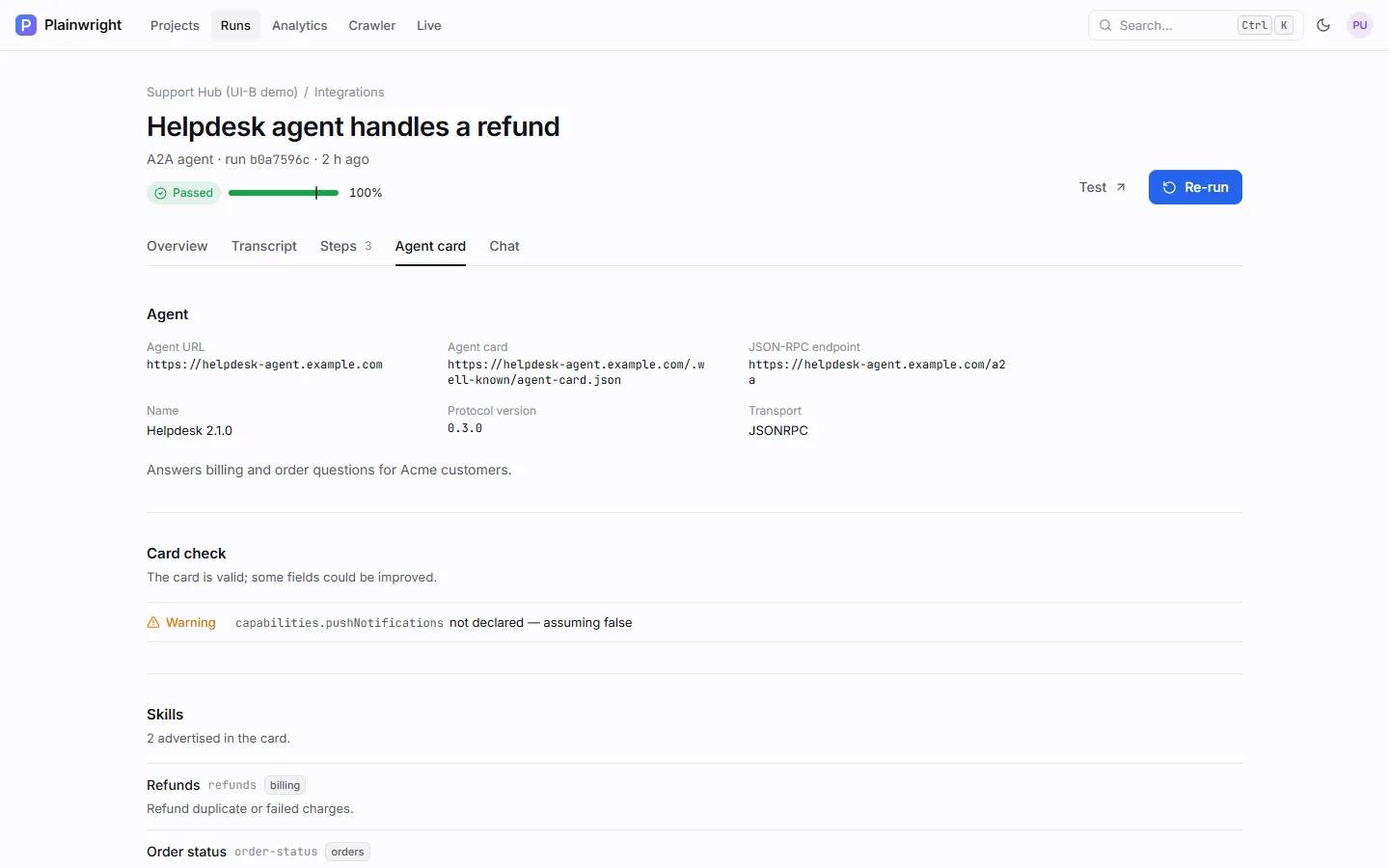
Section titled “Read the result”The Agent card tab shows where the card was found, the JSON-RPC endpoint, the agent’s name, version, protocol version and transport, every validation error and suggestion, and the skills the card advertises.
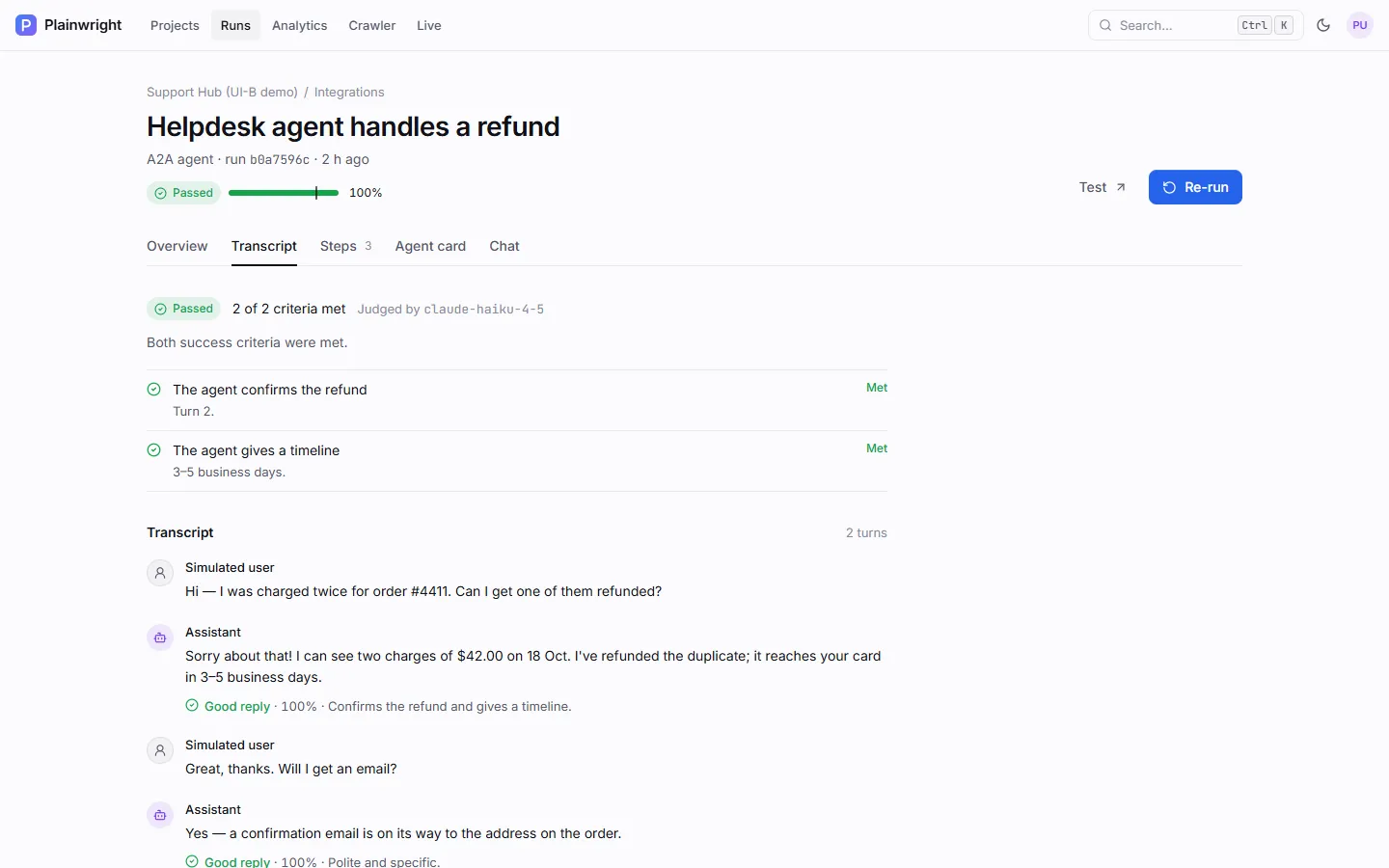
For a conversation, the Transcript tab shows the judge’s verdict per criterion and every turn, as for any conversation test.
| Status | When |
|---|---|
| Passed | The card has no errors (or strict_card is off) and the smoke reply was valid, or the conversation met every criterion. |
| Failed | No card was found, the card has errors with strict_card on, the endpoint isn’t allowed, the smoke message couldn’t be sent or its reply was invalid, failed or empty, or the conversation failed its criteria. |
| Error | No agent URL, an agent URL that isn’t allowed, or the conversation couldn’t run (for example the simulated user’s model or the judge failed). |