RAG evals
A RAG eval is an LLM eval for retrieval-augmented generation. Your endpoint returns the passages it retrieved alongside its answer, and the judge scores four things separately: whether the answer sticks to those passages, whether it answers the question, whether the passages were the right ones, and whether they held everything the answer needed. That tells you whether a bad answer is a retrieval problem or a generation problem.
Run one whenever you change chunking, the embedding model, the retriever or re-ranker, top-k, or the
prompt that turns passages into answers.
What you need
Section titled “What you need”- A dataset with an
inputcolumn, and ideallyexpected(needed for a meaningfulcontext_recall). - An endpoint that returns both the answer and the retrieved passages in its JSON response.
- The target’s
contexts_path: where the passages are in that response. A RAG eval without it stops with RAG evals need the target’s contexts path.
Everything else (body template, headers, sample size, threshold, the run’s guards) works exactly as in an LLM eval.
Point Plainwright at the passages
Section titled “Point Plainwright at the passages”Given this response from your endpoint:
{ "answer": "Yes, we ship to Canada; orders arrive in 5–8 business days.", "sources": [ { "id": "kb-201", "text": "Returns are accepted within 30 days of delivery.", "score": 0.71 }, { "id": "kb-112", "text": "We ship to the US and Canada.", "score": 0.69 }, { "id": "kb-118", "text": "Canadian orders arrive in 5–8 business days.", "score": 0.66 } ]}set response_path to answer and contexts_path to sources[*].text. The judge then receives the
three passages, numbered in the order your retriever returned them.
| Response shape | contexts_path |
|---|---|
{"sources": [{"text": "…"}, …]} |
sources[*].text |
{"contexts": ["…", "…"]} |
contexts |
{"data": {"docs": [{"page_content": "…"}]}} |
data.docs[*].page_content |
{"result": {"citations": [{"snippet": "…"}]}} |
result.citations[*].snippet |
A single string becomes one passage, nested lists are flattened, and objects are passed as JSON. The judge sees at most the first 10 passages, each cut to 1,500 characters.
The four metrics
Section titled “The four metrics”All four come from one judge call per row. The exact wording the judge receives is in the Metrics reference.
| Metric | The question it answers | Compares |
|---|---|---|
faithfulness |
Is every claim in the answer supported by the retrieved passages? | answer ↔ passages |
answer_relevance |
Does the answer address the question that was asked, completely and specifically? | answer ↔ question |
context_precision |
Are the retrieved passages relevant, especially the ones ranked first? | passages ↔ question |
context_recall |
Do the passages contain what is needed to produce the expected answer? | passages ↔ expected answer |
A worked example
Section titled “A worked example”Take one row and three ways the system could get it wrong.
- Question: “Do you ship to Canada, and how long does it take?”
- Expected: “Yes, in 5–8 business days.”
-
Faithfulness. Retrieved: We ship to the US and Canada. / Canadian orders arrive in 5–8 business days. Answer: “Yes, delivery takes 5–8 business days and shipping is free.” The free-shipping claim is in no passage, so faithfulness drops even though the rest is right. A hallucination like this is a generation problem.
-
Answer relevance. Same passages, answer: “We ship to the US and Canada.” True and grounded, so faithfulness is high, but the delivery time was never given: answer relevance drops.
-
Context precision. Retrieved, in order: Returns are accepted within 30 days. / Gift cards never expire. / Canadian orders arrive in 5–8 business days. The useful passage is ranked last behind noise, so context precision drops, even if the final answer is fine.
-
Context recall. Retrieved: We ship to the US and Canada. only. Nothing says how long delivery takes, so the expected answer can’t be produced from the passages: context recall drops. The retriever missed a document.
Read the four together
Section titled “Read the four together”| Pattern | Likely cause | What to try |
|---|---|---|
| Low faithfulness, high context recall | The right passages were there; the model added or changed facts. | Tell the model to answer only from the sources; lower its temperature; show source ids. |
| Low answer relevance | Answers dodge, hedge or answer only part of the question. | Prompt for direct, complete answers; check truncation. |
| Low context precision | Retrieval returns noise, or ranks it above the useful passage. | Add or tune a re-ranker, return fewer passages, improve chunking. |
| Low context recall | The passage the answer needs is never retrieved. | Check the document is indexed, adjust chunk size and overlap, try another embedding model, raise top-k. |
Reference answers and passages in the dataset
Section titled “Reference answers and passages in the dataset”| Column | How a RAG eval uses it |
|---|---|
input |
Sent to your endpoint as {{input}}. |
expected |
The judge’s reference for context_recall (and for correctness, if you add it). |
context |
A ground-truth passage. When a row has no expected, it is shown to the judge in its place, marked as reference context. |
Without either, context_recall is judged against what a complete answer would require, which is
less reliable. Add expected for the questions that matter.
Full example
Section titled “Full example”{ "module_id": "<module-id>", "name": "Help-centre retrieval", "kind": "rag", "natural_language": "The help-centre assistant retrieves the right articles and answers only from them.", "config": { "dataset_id": "<dataset-id>", "target": { "type": "http", "url": "https://rag.example.com/ask", "headers": { "Authorization": "Bearer {{secrets.RAG_API_KEY}}" }, "body_template": { "question": "{{input}}", "top_k": 5 }, "response_path": "answer", "contexts_path": "sources[*].text" }, "metrics": ["faithfulness", "answer_relevance", "context_precision", "context_recall"], "sample_size": 50, "threshold": 0.75 }}In the editor, a RAG eval also offers correctness and latency. Create and run the test as shown in
Work from the API.
Read the result
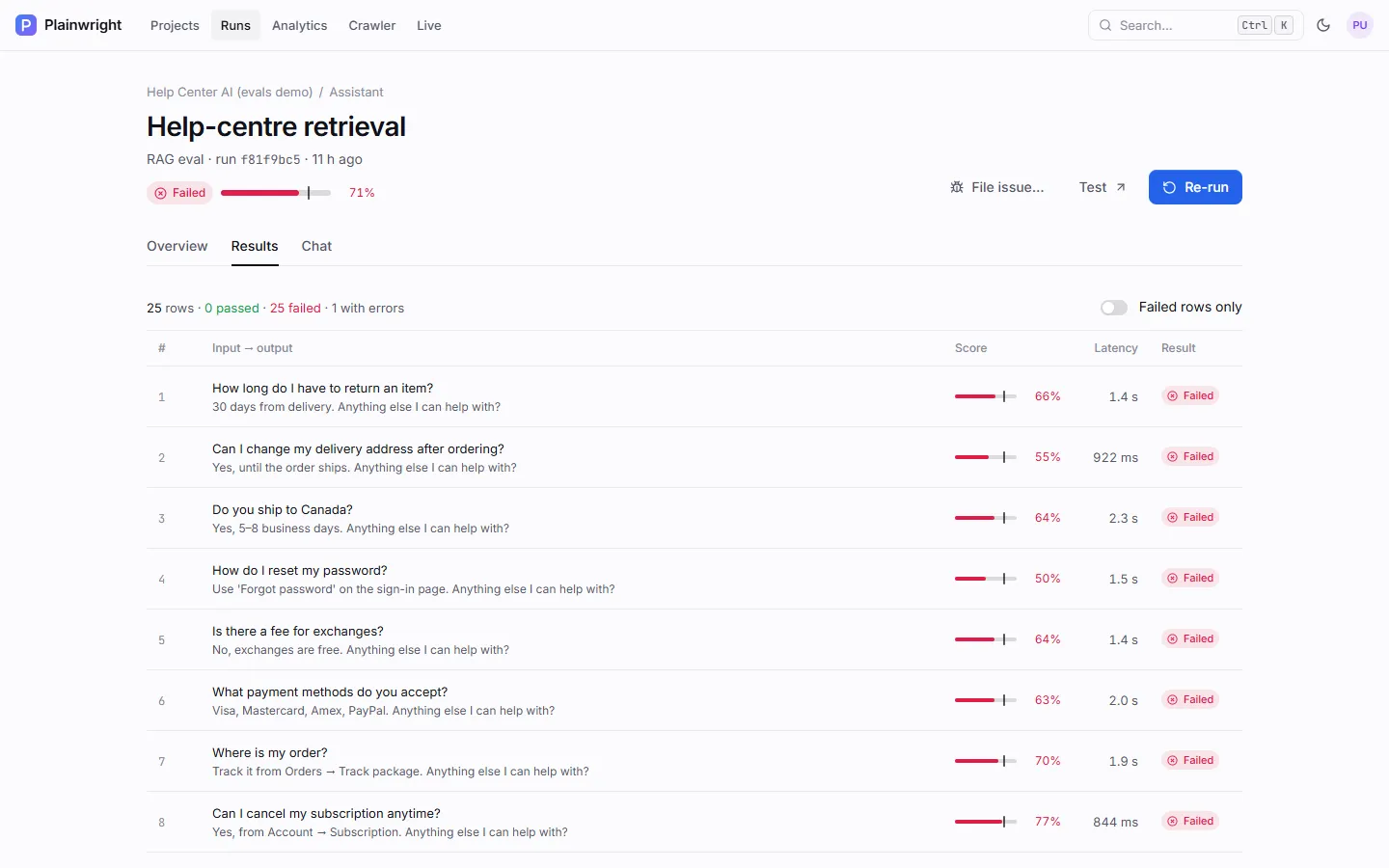
Section titled “Read the result”The Results tab lists every row with its answer, score and latency. Open a row to see each metric’s score and reason, and the retrieved contexts exactly as the judge saw them. That is the quickest way to tell a retrieval miss from a hallucination. Overview shows the mean per metric, so you can see at a glance which of the four is dragging the score down.